Looking for custom products? Explore our complete range of [industrial strip brushes] for sealing, cleaning, guiding and other industrial applications.
What is a strip brush? A strip brush is an industrial brush with bristles arranged continuously along a straight or formed backing. Depending on its construction, a strip brush can be used for sealing gaps, cleaning surfaces, controlling dust and debris, guiding products, wiping components and providing flexible contact between moving or stationary parts.
Strip brushes are available in many different constructions, but they can generally be divided into three main types: metal channel strip brushes, flexible strip brushes and lath brushes. Each construction has different characteristics and installation methods, making it suitable for different industrial applications. In this guide, we explain how these strip brushes are constructed, the materials available and how to choose the right type for your application.
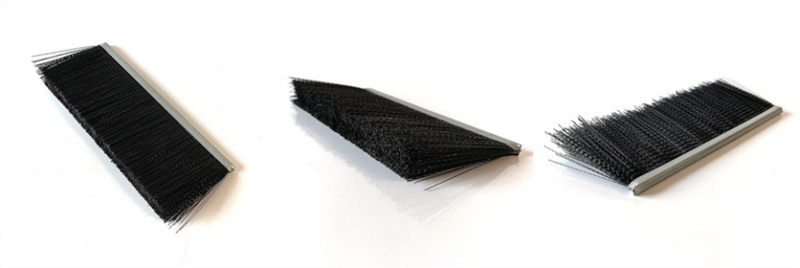
Metal Channel Strip Brushes
A metal channel strip brush is constructed with densely packed filaments secured inside a U-shaped metal channel. During manufacturing, the filament is folded around a retaining rod and mechanically clamped inside the channel, creating a strong and compact brush construction.
The backing is commonly manufactured from galvanized steel or stainless steel, while the filament can be selected according to the application. Nylon and polypropylene are frequently used for sealing, wiping and general cleaning, while steel wire, stainless steel wire, abrasive filament and natural fibers can be used when different levels of stiffness, abrasion or surface contact are required.
Because of its rigid metal backing and high filament density, this type of strip brush is widely used for sealing gaps, controlling dust, wiping surfaces, guiding components and cleaning machinery. Straight metal channel strips can also be formed into rings, cups or spiral configurations for applications that require circular or continuous brush contact.
Key Benefits:
- Strong and durable metal channel construction
- High bristle density for effective sealing and cleaning
- Available with different filament and backing materials
- Customizable bristle height, strip length and overall dimensions
- Can be formed into rings, cups and spiral brushes
Flexible Strip Brushes
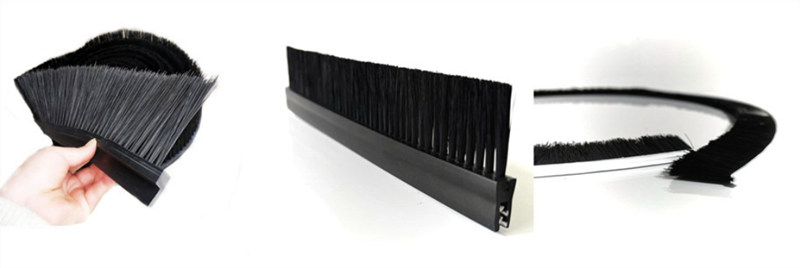
A flexible strip brush uses a flexible thermoplastic or rubber profile as its backing instead of a rigid metal channel. The flexible base allows the brush to bend around curves, corners and irregular profiles, making it particularly useful where a straight rigid strip brush cannot follow the required installation path.
Depending on the design, flexible strip brushes can be manufactured with different profile configurations, including clip-on profiles, H/F-shaped profiles and extruded profiles. Filament material, bristle height, density and profile dimensions can be customized according to the required sealing, wiping or guiding function.
This construction is commonly used for machine sealing, door and enclosure seals, equipment guards, cable management, heat exchanger sealing and other applications involving curved or irregular surfaces. The flexible profile can also simplify installation by fitting directly onto a suitable edge or mounting structure.
Key Benefits:
- Flexible profile for curved and irregular surfaces
- Available in different profile shapes and sizes
- Easy to install on edges and mounting structures
- Customizable filament material, height and density
- Suitable for sealing, wiping and guiding applications
Lath Brushes
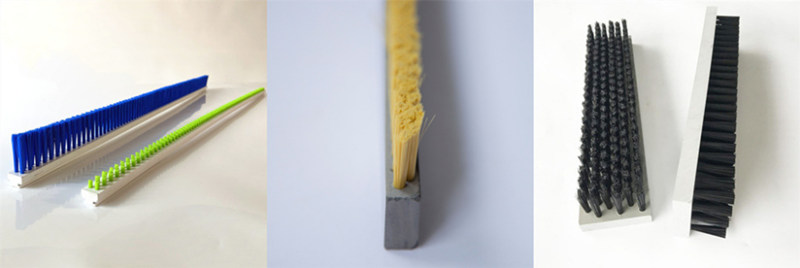
A lath brush, also known as a staple-set strip brush, is manufactured by inserting individual tufts of bristles into a series of holes in a rigid backing. Unlike metal channel and flexible strip brushes, the bristles are positioned in separate drilled or molded holes rather than being held continuously along a channel or flexible profile.
The backing can be manufactured from materials such as PVC, polypropylene (PP), nylon, polyethylene (PE), aluminum or wood, depending on the application. The tuft pattern, spacing, bristle angle, filament material and trim height can all be adjusted during manufacturing. This makes it possible to create straight brush rows as well as specialized brushing patterns for different contact requirements.
Lath brushes are widely used for cleaning, washing, wiping, guiding, supporting products and removing dust or debris. Their rigid backing also makes them suitable for mounting directly onto machinery, conveyor systems and other equipment where a defined brush position and consistent contact are required.
Key Benefits:
- Rigid backing for stable and secure mounting
- Customizable tuft pattern, spacing and bristle angle
- Available with different backing and filament materials
- Suitable for straight or angled brushing configurations
- Cost-effective for cleaning, wiping and guiding applications
What Is a Strip Brush Used For and How Do You Choose One?
Strip brushes are widely used for sealing, cleaning, wiping, guiding and dust control in industrial equipment. The three main constructions — metal channel strip brushes, flexible strip brushes and lath brushes — each offer different advantages depending on the installation method and working conditions.
When choosing a strip brush, consider the required backing type, filament material, bristle height, density and overall dimensions. BaJie Brush can manufacture custom strip brushes according to your drawings, samples or application requirements.