Dust enters manufacturing equipment through door gaps, cable openings, access panels, conveyor transfer points and irregular machine joints. It can accumulate on sensors, moving components and electrical equipment, increasing cleaning requirements and interfering with normal operation.
Brush seals for dust control create a flexible barrier without requiring a completely flat or stationary contact surface. The filaments conform to small surface variations and allow doors, panels, cables or moving components to pass while continuing to cover the surrounding gap.
If you are unfamiliar with the basic constructions, first read What Is a Strip Brush? Types, Materials and Industrial Applications.
Why Use a Brush Seal for Dust Control?
A rigid rubber or plastic seal works best when the contact surface is smooth and the gap remains consistent. Industrial floors, door tracks and machine frames often contain joints, level changes or uneven sections that prevent continuous rigid-seal contact.
Brush filaments flex independently and follow these variations. They do not create an airtight seal, but they can reduce the direct passage of dust, light debris and uncontrolled airflow while allowing normal equipment movement.
Brush seals are commonly used where the installation involves:
- Uneven or changing gaps
- Sliding or rotating components
- Frequent door or panel movement
- Cable pass-through openings
- Curved or irregular mounting surfaces
- Dust mixed with light chips or debris
Choosing the Correct Brush Seal Construction
The backing and mounting method should be selected before the filament material.
Rigid Metal Channel Brush Seals
A metal channel strip brush has filaments folded around a retaining rod and mechanically secured inside a U-shaped metal channel. It can be installed directly or inserted into an aluminum, stainless steel or plastic holder.
This construction is suitable for straight edges such as:
- Industrial door bottoms and sides
- Access panels
- Machine enclosure openings
- Conveyor skirting
- Straight cable-entry openings
Rigid holders provide stable positioning and can include mounting holes or slots for adjustment.
Flexible Brush Seals
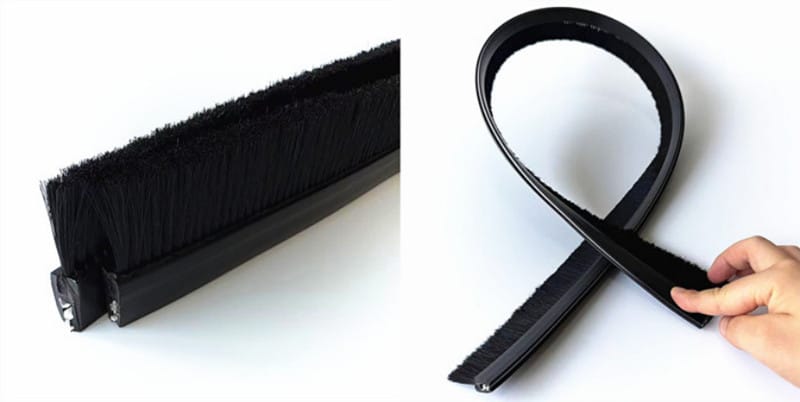
A flexible strip brush uses a bendable plastic or rubber profile. It can follow curved panels, corners and irregular equipment edges where a straight metal channel cannot maintain consistent alignment.
Flexible profiles are useful for machine guards, curved enclosures, vehicle openings and other installations requiring a continuous brush around a changing contour. A flexible brush seal with rubber profile can also be supplied in long lengths for cutting and fitting during installation.
Selecting the Filament Material
Filament selection depends on abrasion, moisture, chemicals, temperature and the surface contacted by the brush.
Nylon
Nylon provides good resilience and wear resistance for doors, access panels and machinery with frequent movement. It is a common general-purpose choice where the filaments repeatedly flex against a surface.
Polypropylene
Polypropylene has low moisture absorption and is suitable for many wet or chemically exposed environments. Chemical compatibility should still be checked against the specific substance used in the facility.
PBT and Other Filaments
PBT can be considered where low moisture absorption and stable filament behaviour are required. Other synthetic or specialty filaments may be selected for temperature, static-control or application-specific requirements.
The material should not be chosen from its name alone. The filament diameter, trim height and density also affect how the brush contacts the surface.
Bristle Density, Trim Height and Mounting
A dust seal must provide continuous coverage without creating unnecessary resistance.
- Bristle Density: Denser filling reduces visible openings through the brush face. The required density depends on particle size, airflow and available installation space.
- Trim Height: The filament must be long enough to cover the gap and maintain light contact with the adjacent surface.
- Filament Diameter: Finer filaments flex easily and conform to small irregularities. Thicker filaments provide firmer contact but require more force to deflect.
- Mounting Angle: Straight and angled holders change how the filaments meet the surface.
- Adjustment: Slotted holes allow the brush position to be corrected as the installation changes or the filaments wear.
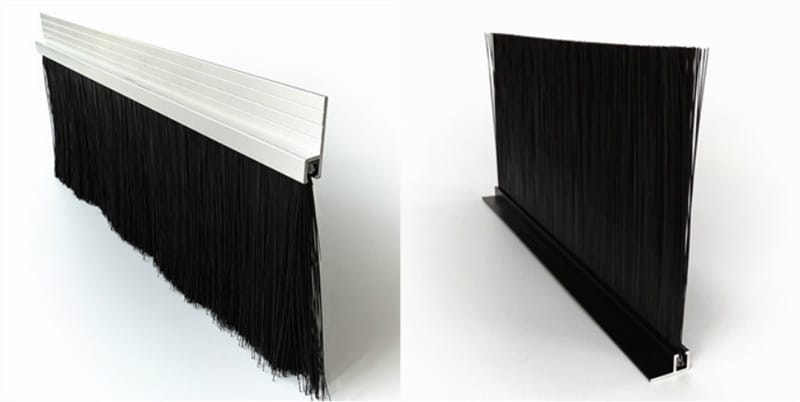
For doors and straight openings, an aluminum-holder assembly such as this door seal strip brush provides a rigid mounting surface and adjustable brush projection.
Check Bristle Retention and Surface Contact
Density alone does not determine whether a brush seal will perform reliably. The filaments must also remain securely fixed in the backing.
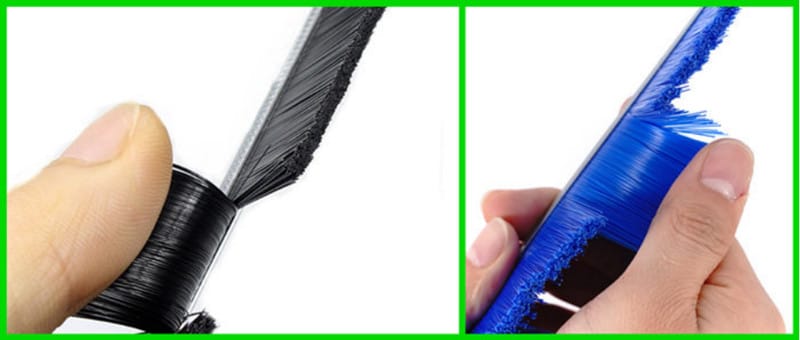
For metal channel brushes, check that the retaining rod and channel crimp hold the filaments consistently along the complete length. For staple-set flexible brushes, the tufts should be checked for secure staple retention.
After installation, inspect the brush from both sides:
- Filaments should cover the complete gap.
- Contact should be continuous along the seal.
- Excessive bending or dragging should be avoided.
- Doors and moving parts should operate normally.
- The backing should remain straight and securely mounted.
Typical Manufacturing Applications
Industrial Doors and Loading Areas
Brush seals cover changing gaps along door bottoms, sides and thresholds. Flexible filaments follow minor floor variations while allowing the door to move normally.
Machine Enclosures
Brushes installed around access doors, guards and moving panels help limit dust, chips and light debris entering protected equipment areas.
Cable Openings and Cabinets
Opposing or offset brush strips allow cables to pass while covering unused space around them. This helps reduce dust ingress without fixing the cables permanently in position.
Conveyors and Transfer Points
Strip brushes can be mounted along conveyor edges and transfer zones to contain light dust and material. Filament stiffness and contact pressure must be selected so the brush does not interfere with belt movement.
Information Needed to Specify a Dust Seal Brush
Before requesting a quotation, provide:
- Overall seal length
- Gap size and whether it changes
- Straight, curved or irregular mounting shape
- Required filament contact
- Exposure to moisture, chemicals, heat or sunlight
- Available mounting space
- Preferred fixing-hole positions
- Drawing or photographs of the installation
These details are more useful than requesting a “standard dust brush,” because brush height, density and mounting profile must correspond to the actual gap.
Frequently Asked Questions
What is the best filament for industrial dust control?
Nylon is a practical general-purpose choice for high-cycle applications. Polypropylene may be preferable where low moisture absorption or chemical exposure is important. The final selection depends on the working environment.
Are brush seals airtight?
No. Brush seals create a flexible particulate and airflow barrier, but they are not airtight. Applications requiring pressure containment may need an additional rubber, foam or engineered sealing element.
How much should the bristles contact the surface?
The filaments should cover the gap and make light, continuous contact. Excessive deflection increases friction and wear, while insufficient contact leaves an open path for dust.
Can a brush seal follow a curved surface?
Yes. Flexible rubber or thermoplastic profiles can follow curved and irregular edges. Rigid metal channel brushes are more suitable for straight mounting positions.
When should a dust seal brush be replaced?
Replace or reposition the brush when filaments become uneven, permanently bent, shortened or no longer cover the complete gap. Loose backing or filament loss also indicates that replacement is required.
What should I provide for a custom brush seal?
Provide the overall length, gap size, mounting shape, required contact, working environment and available fixing details. A drawing or photographs with marked dimensions are recommended.