This climbing rope cleaning brush case study describes how BaJie Brush developed a custom inside spiral brush for ClimbClean, a U.S. company specializing in handheld climbing rope cleaners.
The project began with a trial sample. The brush needed to fit accurately inside ClimbClean’s existing plastic housing while providing continuous contact around the rope. After the sample passed the customer’s fit and cleaning tests, ClimbClean placed an initial order for 200 units.
Customer and Application
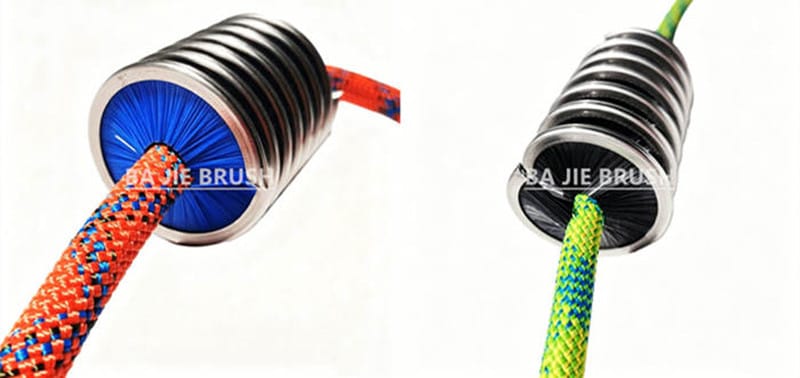
ClimbClean’s handheld device is designed to help remove surface dirt from climbing ropes. Its plastic housing contains an inside spiral brush, and the rope passes through the centre of the brush during cleaning.
Unlike a general-purpose brush, this component had to match the housing dimensions accurately. An incorrect outer diameter or length could prevent installation, while an unsuitable inner diameter or filament arrangement could affect contact with the rope.
Kyle from ClimbClean therefore requested a sample before proceeding with a production order.
Required Brush Specifications
Kyle provided the principal dimensions and construction required for the trial:
| Specification | Requirement |
|---|---|
| Outer diameter | 50 mm |
| Inner diameter | 10 mm |
| Overall length | 90 mm |
| Number of turns | 7 |
| Filament material | Black nylon |
| Backing material | Stainless steel |
| Brush type | Inside spiral coil brush |
| Application | Cleaning climbing ropes |
The stainless steel backing forms the structural spiral, while the nylon filaments face inward toward the rope. As the rope passes through the centre, the bristles contact it around the circumference.
The nylon filaments also needed to provide cleaning contact without introducing unnecessarily aggressive abrasion to the rope surface.
Three-Day Sample Production
After reviewing the dimensions, our production team produced the trial sample within three days.
The main production controls included:
- Maintaining the specified 50 mm outer diameter
- Forming seven consistent spiral turns
- Controlling the 10 mm internal opening
- Keeping the finished length at 90 mm
- Securing the nylon filaments inside the stainless steel backing
- Checking that the completed brush retained its cylindrical form
Because the brush was intended for installation inside an existing housing, dimensional consistency was particularly important. The finished sample was inspected and then shipped by air to ClimbClean in the United States.
Housing Fit and Cleaning Test
ClimbClean tested the sample for approximately one week. The evaluation focused on two practical requirements.
First, the spiral brush had to fit correctly inside the plastic housing without additional modification. Second, the internal nylon filaments needed to maintain contact with the climbing rope and provide the required cleaning action.
The customer confirmed that the sample fitted the housing and performed successfully during testing.
Customer Feedback
After completing the evaluation, Kyle sent the following feedback:
“Good morning Rosa, we received the sample brushes, and are pleased with the quality. The stainless steel and nylon bristles are exactly what we need.
I’d like to process an initial order of 200 units, as we discussed.
Let me know how to submit that order! We look forward to receiving the parts.”
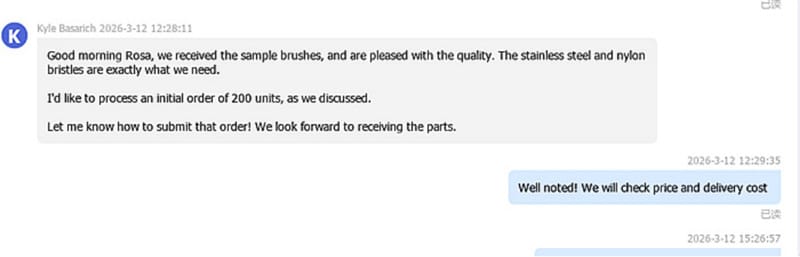
The feedback confirmed both the material selection and the sample’s suitability for ClimbClean’s product. More importantly, the trial progressed directly to an initial production order of 200 brushes.
Initial 200-Unit Order
For the production order, the approved sample became the reference standard. The same dimensions, material combination and seven-turn construction were retained for batch manufacturing.
Quality checks for the production batch focused on:
- Outer and inner diameter consistency
- Overall brush length
- Number and spacing of turns
- Bristle retention
- Stainless steel backing formation
- Comparison with the approved sample
Using the approved sample as the production reference reduced uncertainty and ensured that the supplied brushes remained compatible with the customer’s housing.
Why an Inside Spiral Brush Works for Rope Cleaning
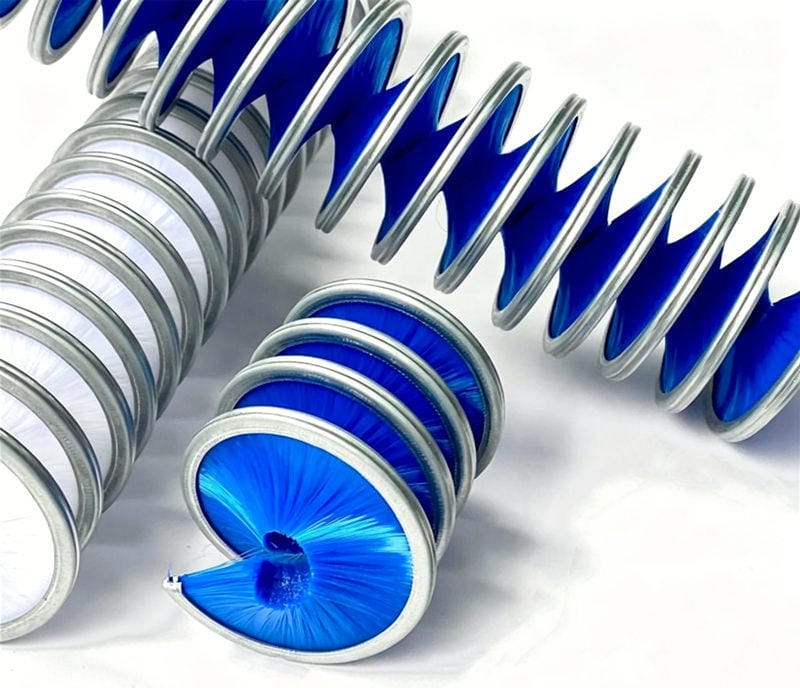
An inside spiral brush surrounds the workpiece rather than contacting it from only one side. This construction provides several advantages for rope-cleaning equipment:
- Contact around the rope circumference
- Compact installation inside a handheld housing
- Continuous cleaning as the rope moves through the brush
- Customizable inner and outer diameters
- Adjustable brush length and number of turns
- A choice of filament and backing materials
The internal diameter, filament stiffness and bristle density must be selected according to the rope diameter and required cleaning intensity. Excessively stiff filaments or an undersized opening may create unnecessary resistance, while an oversized opening may reduce cleaning contact.
Sample Approval and Initial 200-Unit Order
This project progressed from drawing and specification review to a completed sample in three days. After approximately one week of customer testing, the brush passed both the housing-fit and cleaning-performance evaluations and resulted in an initial 200-unit order.
The case demonstrates the value of sample testing when a custom brush must integrate with an existing product. Instead of selecting a spiral brush only by nominal dimensions, the customer was able to verify installation, material suitability and actual cleaning performance before batch production.
For technical details and customization options, see our Climbing Rope and Cord Cleaning Nylon Inside Spiral Brush.
Customers developing similar rope or cord cleaning equipment can provide the housing dimensions, rope diameter, required filament material and expected cleaning action for evaluation.