Mr. D, representing a UK sealing products distributor, contacted BaJie Brush to develop a high-density flexible strip brush as an alternative to the company’s existing European supply.
The challenge was not simply adding more bristles. The finished brush also needed to remain flexible while holding every tuft securely during installation and use.
Customer Requirements
The customer supplied an existing brush specification with three important requirements:
- Flexible profile size: 9 × 18 mm
- Bristle arrangement: two rows
- Tuft density: 61 holes across the two rows per 100 mm of profile
This was substantially denser than a conventional flexible brush strip. The profile still needed to bend around the required installation path without loosening the densely packed tufts.
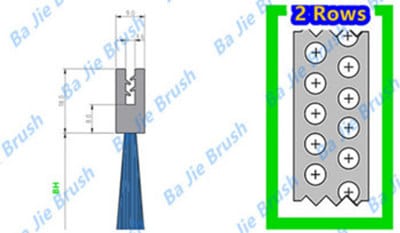
The customer had previously tested samples from several alternative suppliers, but the submitted brushes did not provide the required combination of density, flexibility and secure filament retention.
Why the Initial Samples Failed
Our first sampling trials revealed a conflict between tuft density and retention strength.
When we increased the number of tufts, the available material between adjacent holes became limited. This reduced support around each tuft and made some bristles easier to pull from the profile.
When we increased the anchoring strength, the profile became harder to process at the required hole spacing. Reducing the number of holes improved retention but no longer met the customer’s density specification.
The solution therefore required changes to both the profile material and tufting process.
Adjusting the Flexible Profile
We tested different thermoplastic profile formulations to find a suitable balance between firmness and flexibility.
A profile that was too soft could deform around closely spaced holes and provide insufficient support for the tufts. A profile that was too hard improved retention but reduced the flexibility required for coiling, transport and curved installation.
After several trials, we selected a formulation that could:
- Support the closely spaced tuft pattern
- Hold the bristles firmly
- Bend without cracking
- Recover after coiling
- Maintain the required 9 × 18 mm profile dimensions
Improving the Tufting Process
Profile material alone could not solve the problem. The planting equipment and processing parameters also needed adjustment.
Our production team modified the tufting setup to improve planting depth, spacing accuracy and anchoring consistency. Trial pieces were then checked for:
- Tuft quantity per 100 mm
- Alignment of both bristle rows
- Bristle pull resistance
- Profile deformation
- Flexibility after tufting
- Consistency along the complete sample length
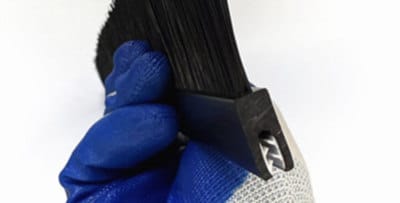
The brush passed after four internal sampling rounds. The final construction achieved the required 61-hole arrangement while maintaining secure filament retention and profile flexibility.
Final Brush Construction
The approved high-density flexible strip brush incorporated:
| Specification | Final Construction |
|---|---|
| Profile size | 9 × 18 mm |
| Profile type | Flexible clip-on profile |
| Bristle rows | Two |
| Tuft density | 61 holes per 100 mm across both rows |
| Profile properties | Balanced firmness and flexibility |
| Main improvement | Higher density with secure tuft retention |
| Supply format | Coiled flexible strip |
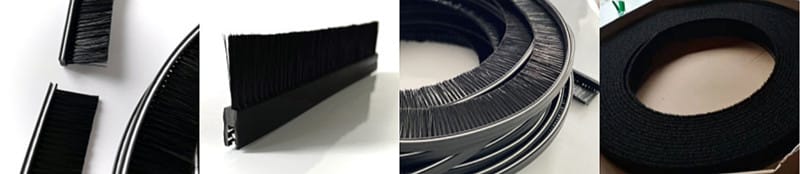
The brush could be coiled for handling and transport, then unrolled for installation without permanently deforming the profile.
Customer Feedback and Project Result
Mr. D approved the completed samples after confirming the 9 × 18 mm profile, two-row construction and required tuft density. The bristles also remained securely retained during bending and manual checking.
After evaluating the samples, Mr. D commented:
“BaJie Brush has delivered German-level quality at a much more competitive price. This not only saves us significant costs but also strengthens our competitive advantage in the local market.”
He also described BaJie Brush as:
“The best flexible strip brush manufacturer in China, with a true spirit of perseverance and co-development.”
For Mr. D, the result provided a more cost-effective alternative to his previous European supply without reducing the required product performance. For our production team, the project established a repeatable method for manufacturing densely tufted flexible profiles where standard tufting parameters are insufficient.
Customers can now specify profile dimensions, bristle rows, filament material, trim height and tuft density according to their sealing application.
What This Project Demonstrates
This case shows why a custom flexible strip brush cannot be evaluated by appearance or bristle density alone. Profile hardness, hole spacing, tuft anchoring and bending performance must work together.
For applications requiring a curved or clip-on sealing profile, see our Clip On Style Profile Flexible Rubber Sealing Strip Brush and other flexible strip brush options.
To evaluate a similar project, provide:
- Profile drawing or physical sample
- Required profile dimensions
- Filament material and diameter
- Bristle rows and trim height
- Required tuft density
- Installation shape and operating conditions
BaJie Brush can then assess whether an existing profile is suitable or whether the material and tufting process need to be adjusted.