The principal strip brush materials are the backing that supports the brush and the filaments that contact the workpiece. Common backing materials include galvanized steel, stainless steel, aluminum and plastic profiles. Filaments may be made from nylon, polypropylene, PBT, metal wire, abrasive nylon or natural fibres.
The correct combination depends on what the brush must do, the environment in which it operates and the surface it contacts. A material suitable for closing a door gap may not be appropriate for removing rust or guiding products on a conveyor.
For an overview of the main constructions, read What Is a Strip Brush? Types, Materials and Industrial Applications.
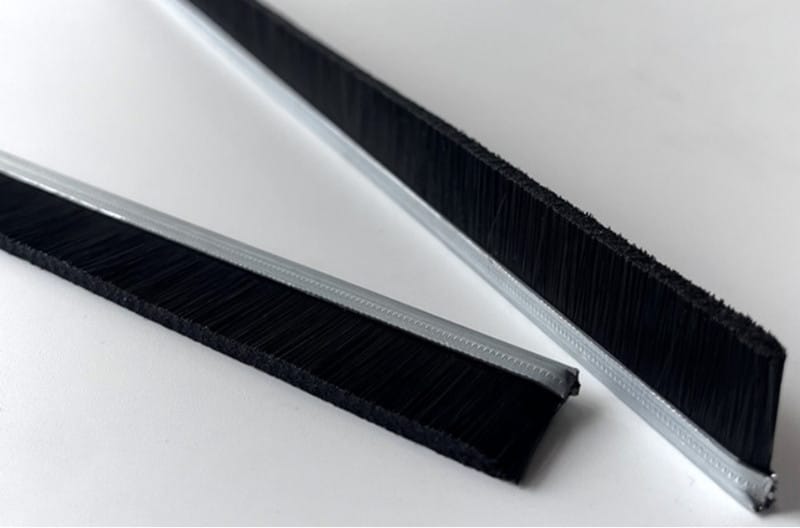
Basic Strip Brush Construction
A metal channel strip brush normally consists of three components:
- Backing strip: formed into a U-shaped metal channel
- Filaments: folded and packed continuously along the channel
- Retaining rod: positioned inside the folded filaments before the channel is mechanically closed
The retaining rod and formed channel secure the filaments without using individual drilled holes.
Other constructions use different bases. Flexible strip brushes may use thermoplastic or rubber profiles, while lath brushes use separate tufts inserted into a rigid plastic, metal or wooden backing.
This article focuses primarily on the materials used in metal channel strip brushes, while also explaining the main synthetic, metal and natural filament options.
Strip Brush Backing Materials
Galvanized Steel
Galvanized steel is the standard backing material for many general industrial strip brushes. The zinc-coated surface provides more corrosion protection than untreated carbon steel while remaining economical and easy to form.
It is commonly used for:
- Door and enclosure sealing
- Conveyor cleaning and guiding
- Machinery guards
- General dust control
- Indoor and moderately exposed equipment
Galvanized steel is suitable when the backing will not remain continuously wet or be exposed to aggressive chemicals. Cut edges and damaged coatings can still corrode, so it should not automatically be treated as a substitute for stainless steel.
Stainless Steel
Stainless steel backing is selected where moisture, hygiene or corrosion resistance is more important.
Typical applications include:
- Food-processing equipment
- Pharmaceutical and laboratory equipment
- Outdoor installations
- Wet-cleaning systems
- Marine or humid environments
- Equipment exposed to compatible chemicals
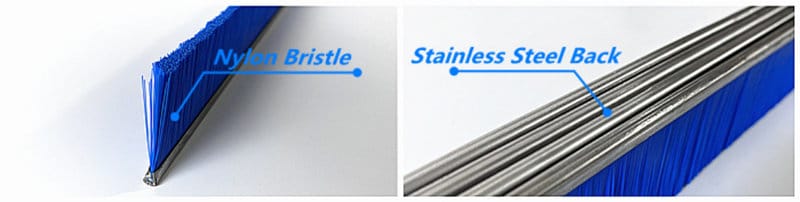
The stainless steel grade should be selected according to the actual environment. Stainless steel improves corrosion resistance, but no grade is resistant to every acid, alkali, chloride or cleaning chemical.
Aluminum Holders
Aluminum is commonly used as a separate mounting holder rather than as the U-shaped backing that directly clamps the filaments.
A completed metal channel brush can slide or be pressed into an aluminum profile to provide:
- Easier screw mounting
- Additional backing stiffness
- A clean finished appearance
- Replaceable brush inserts
- Straight installation over longer lengths
Aluminum profiles may be mill-finished or anodised according to the installation and appearance requirements.
Plastic and Flexible Profiles
Not every strip brush uses a metal channel. Flexible and clip-on brushes may use thermoplastic rubber or plastic profiles, while staple-set lath brushes can use PVC, PP, nylon or other rigid backing materials.
These profiles are selected when the application requires:
- Installation around curves
- Clip-on mounting
- Electrical insulation
- Reduced weight
- A drilled or molded tuft pattern
- A non-metallic base
Strip Brush Filament Materials
Nylon
Nylon is one of the most widely used synthetic strip brush filaments because it combines flexibility, wear resistance and good recovery after bending.
Common nylon grades include PA6, PA66, PA610 and PA612. Their moisture absorption, stiffness and environmental resistance differ, so “nylon” should not be treated as one uniform material.
Nylon is commonly used for:
- Door and machine sealing
- Repeated wiping
- Conveyor cleaning
- Product guidance
- Equipment with moving contact
- General industrial cleaning
For a detailed comparison, see Nylon vs Polypropylene Strip Brushes: 6 Key Differences.
Polypropylene
Polypropylene is economical, lightweight and absorbs very little moisture. It also provides useful resistance to many chemicals, although compatibility must be checked against the exact substance, concentration and temperature.
It is commonly selected for:
- Wet or humid areas
- General dust barriers
- Light-duty sealing
- Compatible acidic or alkaline environments
- High-volume, cost-sensitive applications
Compared with nylon, polypropylene usually provides lower wear resistance and elastic recovery under repeated friction.
PBT and Other Polyester Filaments
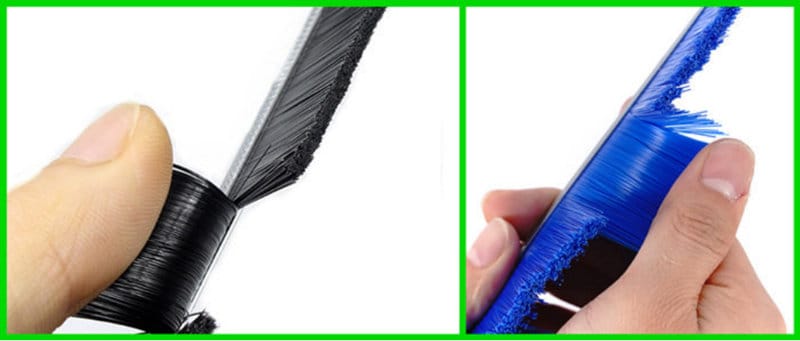
PBT is used when low moisture absorption and good dimensional stability are required. It can provide a useful balance between nylon-like resilience and better stability in wet conditions.
Possible applications include:
- Wet processing equipment
- Outdoor installations
- Repeated washing
- Applications requiring stable filament stiffness
- Selected food-contact or regulated equipment when an approved grade is specified
Material-grade documentation must be checked when food-contact, flame-retardant or other regulatory compliance is required.
Carbon Steel Wire
Carbon steel wire produces a more aggressive brushing action than synthetic filament. It is suitable for removing rust, scale, loose coatings and heavy contamination from compatible metal surfaces.
Common uses include:
- Surface preparation
- Weld cleaning
- Rust and scale removal
- Cleaning industrial tooling
- Concrete block production equipment
Carbon steel wire can corrode in wet conditions and may leave ferrous contamination on stainless or non-ferrous surfaces.
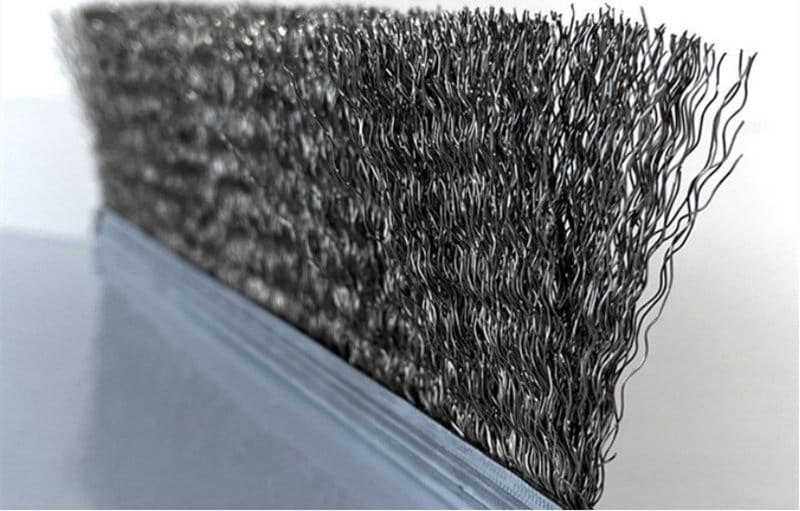
Stainless Steel Wire
Stainless steel wire is used when wire brushing is required together with improved corrosion resistance or reduced risk of ferrous contamination.
It is commonly selected for:
- Stainless steel workpieces
- Wet industrial cleaning
- Food-processing machinery
- Surface preparation in corrosive environments
The wire grade, diameter, crimp and filament density all influence brushing strength.
Brass and Copper-Alloy Wire
Brass or other copper-alloy wire provides a less aggressive action than many steel wires. It may be selected for compatible non-ferrous components, light surface cleaning or applications where steel-wire contamination is undesirable.
The workpiece material should still be tested because even relatively soft wire can mark a sensitive surface.
Abrasive Nylon
Abrasive nylon contains abrasive particles such as silicon carbide or aluminum oxide within a synthetic filament.
It is used for:
- Deburring
- Edge radiusing
- Surface finishing
- Removing light oxidation
- Cleaning without exposed metal wire
The abrasive type, grit size, filament diameter and brush pressure determine the finish produced.
Horsehair
Horsehair is a soft natural filament used where gentle contact and fine dust handling are required. It is often selected for:
- Delicate surface cleaning
- Light sealing
- Fine dust removal
- Polishing
- Equipment where soft filament contact is important
Horsehair is often described as suitable for static-sensitive applications, but a brush should not be claimed as electrically conductive or certified anti-static unless its complete construction has been tested for that purpose.
Tampico Fibre
Tampico is a natural plant fibre that absorbs and releases liquids effectively. It provides a relatively soft brushing action and is commonly used for:
- Polishing and finishing
- Applying liquids or compounds
- Cleaning sensitive surfaces
- Woodworking applications
- Applications where natural fibre is preferred
Natural fibres can vary more than synthetic filaments in diameter, colour and stiffness.
Quick Material Comparison
| Material | Main Advantage | Main Limitation | Typical Use |
|---|---|---|---|
| Galvanized steel backing | Economical and formable | Limited in continuously wet conditions | General sealing and cleaning |
| Stainless steel backing | Improved corrosion resistance | Higher cost | Wet, hygienic and outdoor equipment |
| Nylon filament | Wear resistance and recovery | Absorbs more moisture than PP or PBT | Repeated wiping and moving contact |
| Polypropylene filament | Low moisture absorption and economical | Lower wear resistance | Wet areas and general sealing |
| PBT filament | Dimensional stability in moisture | Higher material cost than PP | Wet processing and repeated washing |
| Carbon steel wire | Aggressive cleaning | Can corrode or contaminate surfaces | Rust and scale removal |
| Stainless steel wire | Wire action with corrosion resistance | More expensive than carbon steel | Stainless and wet applications |
| Abrasive nylon | Controlled finishing without exposed wire | Finish depends strongly on grit and pressure | Deburring and surface preparation |
| Horsehair | Gentle contact | Natural variation | Fine dust and delicate cleaning |
| Tampico | Liquid retention and soft polishing | Less consistent than synthetic filament | Polishing and compound application |
How to Select Strip Brush Materials
Before choosing a backing and filament combination, identify:
- The required function: sealing, cleaning, guiding, polishing or surface preparation
- Whether the brush works indoors, outdoors, wet or dry
- The normal and maximum operating temperature
- Any acids, alkalis, solvents, oils or cleaning agents present
- The workpiece material and acceptable surface finish
- Contact pressure and operating frequency
- Hygiene, flame-retardant, food-contact or electrical requirements
- Required brush life and replacement method
Material selection should be based on the complete operating environment rather than a single property. For example, stainless steel backing may solve a corrosion problem, but the filament must still be compatible with the temperature, chemical exposure and workpiece surface.
BaJie Brush can manufacture strip brushes using different backing, holder and filament materials. Send us the application conditions, drawing or sample, and we can evaluate an appropriate material combination.